Sunday, November 2, 2008

Companion Ponies

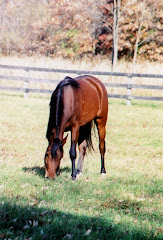
I can't tell you too much about the Shetland pony named Little Katie and how she saved the life of a giant Hanoverian gelding named Nick, because their complete story is told in the sequel to my middle grade novel, The Tugboat Chronicles. But I want to make a point about the value of companion ponies, and show how there really is a job for any horse.

For a variety of reasons, Nick, a former event horse, was in a deep depression when I first met him. He was a mere shell of the one time gorgeous 17H show horse, and lived in a stall by himself.

Little Katie is a tiny Shetland pony whose career has been spent meeting children in classrooms, making nursing home visits, and keeping lonesome horses company. Little Katie is so small she could walk right underneath Nick without her back brushing against his belly. But when we decided to put the two of them together in the same stall, Nick's life turned around and he slowly began to get better.

I have a friend who donated her un-ridable horse to a hunt club who put his quiet nature to good use teaching the hound puppies how to manage themselves around a horse. Another person donated her horse to a therapeutic riding program, and he is now giving intellectually challenged kids and adults the opportunity to explore the world of horses. And yet another well loved barrel racer whose leg injury meant she could never be ridden again, went to live in the backyard of a wheelchair bound former equestrian as her companion.

Peoples spirits are lifted, lives are changed, hope is regained and loneliness abated by the presence of a horse or a pony. Other horses who need companions make faster recoveries when allowed to live as nature intended, in the company of other equines. Although it might take a little time to find just the right place for a horse in need of a new job or place to retire, there are opportunities out there.

If you aren't sure how to find a home for your horse, start by contacting your state university agriculture department. If your community has a therapeutic riding program, find out if they are in need of horses. Or, type "where to donate a horse" into a search engine and you will have hundreds of organizations to contact.

A good resource for information and to be sure you are donating your horse to a reputable organization is the Equine Protection Network. Another favorite is Habitat for Horses, sponsored in part by Willie Nelson and his daughter, Amy.

Thursday, October 30, 2008

Vote "YES" on Question 2 in Maryland!


It feels like the equestrian industry in Maryland is standing on the edge of a cliff, waiting for Tuesday's election to know whether or not to jump. Already so many Marylander's travel to Delaware, West Virginia and other states to spend their money at the horse races, because those states have slots.

It's pretty simple: no slots, no racetracks, no Preakness, no flourishing horse businesses in Maryland. The horses will go away.

By voting "Yes" to Question 2, the horse racing industry in Maryland will be revitalized, and 55% of the money the state gets from the income of the slot machines will poor into our school systems.

Please, if you live in Maryland and can vote, vote "YES" on Tuesday, November 4th!

Sunday, October 19, 2008

Good Decisions

It was the right decision to move my bedroom into the closet. This morning I rose early, couldn't wait to get to the computer and start writing again.

Today is one of those perfect October days one dreams about all summer. It is still too chilly to prop open the window of my new office, but I am surrounded by the colors of autumn outside.
The red maple is going to be stunning within just a few days. Peach and Scout, my two lovely golden retrievers, watched from their fenced in yard as pheasants rose from the tall grassy fields just a few moments ago, the male screeching as his wings beat against the wind.

It is the kind of day when one buys a pumpkin, but I wouldn't have known from my old office downstairs. I wouldn't have been part of it in that cold, fluorescent room. Yes, it was the right decision to live in the closet for now, while I finish my book.

Saturday, October 18, 2008

In The Interest of Writing a Middle Grade Novel

Well I suppose I am officially eccentric/crazy/just-plain-weird as of today. I have moved my bedroom into my closet.

Why? Well, two reasons: One, my head hurts at the end of each day after working on a computer for 8 hours under fluorescent lighting at my office. Consequently, when I get home I am in no mood to go back to the computer under more fluorescent lighting, in a room with one small window, dark paneled walls and a tile floor. I haven't written anything in over a month, and I am so close to finishing my novel, I had to move my desk and computer upstairs into my old bedroom with its wall of windows facing the fields and woods out back. It is a beautiful, serene, and sunlight filled view and its just plain and simply better for the juju.

So I don't appear certifiable, you should know my "closet" was probably a nursery when the house was built almost 100 years ago, so it is big enough for my double bed, tv, table, etc. Its actually kind of cozy, complete with the slanted ceilings of a Cape Cod and a mini closet, too.

A fun fact about MD history: when this house was built, a persons home was taxed according to how many closets it had, not bedrooms. Hmmm.

#2 reason is because, being able to say that I "lived in a closet" while finishing my blockbuster pony novel adds a bit of color to my bio when I am a rich and famous author of The Tugboat Chronicles, right? Always have to plan ahead! :-)


Friday, September 26, 2008

Say "No" To Horse Slaughter!

The subject of horse slaughter in America, or transport of horses to slaughter in other countries, is one that will make most horse lover's blood boil. There are many people who are working hard to get laws passed to protect horses in our country from ending their life in this tragic and disrespectful way. Progress is being made, bit by bit, by people who work hard for this cause.

It is sad to know that many of the horses sent to slaughter houses were once beautiful, athletic racehorses who ran their hearts out to make a few dollars for their owners and trainers. Unfortunately, sending a horse off to an auction known to sell to slaughter houses doesn't bother many of these people. Their horses are part of a business for profit, and when they aren't useful anymore, the owners/trainers discard them without a thought.

Country music legend Willie Nelson has spoken publicly against horse slaughter, and actively supports the Habitat for Horses equine rescue. His daughter, Amy Nelson, has made it her life's mission to get a bill passed in Congress that would make it illegal to transport, sell, deliver, or export horses for slaughter.

But the way to make a change happen doesn't only take place in Washington. It must also come from the hearts of people who can, and are willing to, make a difference.

Suffolk Downs Racetrack
outside Boston, MA, has taken a stand, and made the brave decision to ban trainers from its track if they sell a horse for slaughter. This is especially significant because this operation is in the midst of a Phoenix-like rebirth ~ financed by one of the tracks partners, Richard Fields ~ and is banking on trainers flocking to the newly refurbished track in droves.

But a risky move like this, to say "Come to my track and race, but only if you treat your horses with the dignity they deserve," is a policy that might very well change the way racetracks operate in the future. Already one of the country's most well known trainers, Nick Zito, has agreed to bring his horses to the track in part because he supports this policy.

My thought when I first read about Richard Fields and Sam Elliott, Suffolk's vice president for racing, was "Finally!" Thank God someone has the guts to take a stand! Someone has the heart, as well as the power, to turn the tide and begin to make a difference! It is the brave move by a couple of mavericks with heart. And now, let's see who is gutsy enough, who has the courage and decency to follow their lead. Personally, I'm banking on the trickle down effect.

The more publicity this policy gets, the more tracks that may follow this remarkable example of true horsemanship. The more noise made in Washington, the closer we come to horse slaughter being a thing of the past. When people take the first step, as Richard Fields, Sam Elliott, Willie and Amy Nelson have done, it is easier for others to follow. Hopefully this will happen.

But even if it doesn't, even if only a handful of horses are saved from a desperate ending to a life in which they gave all they had, well that's a pretty remarkable beginning. My hat is off to you all! Thank you for making a difference.

For more information about how you can help support Habitat for Horses, see my August 18th blog
by clicking here.

Related links:
* Suffolk Downs new policy
* Habitat for Horses web site
* Trainer Nick Zito's support of the ban
* Richard Fields philanthropy
* Willie Nelson's web site

Saturday, September 20, 2008

History of Dressage

Years ago I heard the father of one of my students say that watching his daughter ride dressage was like watching paint dry. Not one to let a teaching opportunity slip past me, I asked him if he knew the origins of dressage, and if he understood what the point was, and where it's place was in both military and equestrian history. Of course, he looked at me dumbfounded like he'd been caught making a sexist comment in front of a feminist. I may not be a "classic feminist", but I do understand and appreciate the benefits of dressage training.

Over two thousand years ago the ancient Greeks knew that in order to use their horses to their best advantage in battle, they must be in perfect condition, and be completely obedient to the will of the rider. The soldiers lives depended on it.

With their appreciation for the laws of nature and physics, the Greeks knew they had to be able to use the horse's natural athletic abilities to move quickly from side to side, to dodge a sword swung in their direction, to jump from one place to another, to change direction in an instant, to halt, then burst forth at full speed without any challenges or hesitation from their mounts. And they needed to be able to accomplish this with the simple shifting of a seat bone, the tightening of a calf muscle, or the closing of one finger on the reins.
The first published papers on this type of training came from the Greek Commander Xenophon, born in 430 BC. See http://horsemanship.suite101.com/article.cfm/xenophons_the_art_of_horsemanship

The movements that we see today in dressage competitions come from these same military maneuvers. It is an exacting science, and one that only years of training result in the desired precision of movement. All other disciplines of riding, whether jumping, barrel racing, polo, reining or pleasure riding, benefit from dressage training.

A horse that is schooled in dressage will be more supple, will use it's own body more naturally in collection, will develop stronger muscles, healthier heart and lungs, and be more obedient to the rider. Any horse, whether one involved in some sort of competition, or your trail horse you canter through the woods, will be a better mount, and will be more athletic, with even a very basic level of dressage training.

If you want to see what this looks like in person, and get a better understanding why it was so important to the military, I recommend spending an evening at Medieval Times (http://www.medievaltimes.com/) You will enjoy a dinner worthy of any Middle Age court, and see competitions and demonstrations of such magnificent movements as piaffes, tempi changes, passage, half-pass and pirouettes.

For more detailed information about dressage, go to http://www.usdf.org/about/about-dressage/history.asp or http://www.schumachersporthorses.com/history_of_dressage.htm. These web sites will give you a lot of valuable information about the important history and use of dressage in today's equestrian sports.

Oh and that Dad? He started taking riding lessons the next week, and today owns a small farmette where he keeps his own stable of horses.

Saturday, September 6, 2008

Show Jumpers vs. Show Hunters, Part II

My niece told me that the two sides of her family were very different: Her Dad's side reminded her of the very "proper" British family, while her Mom's side reminded her of the typical boisterous Irish clan. The difference between show hunters and show jumpers can be compared in somewhat similar ways.

Show hunters, as discussed, have a more polished, quiet and refined manner, and the judging in the ring is very subjective. Not so the very agile, energetic and animated show jumpers. A show jumper will be more elevated, or "up" in front end, and powerful hindquarters should be placed well under its body to help it through tight turns and over larger jumps. Show jumpers tend to be a little more "hot-tempered" than a hunter, as they need the extra boost of enthusiasm to get through the tricky and difficult courses.

The most common myth about show jumpers is that "it's all about speed." Yes, the horse with the best time wins. But it isn't because they were the fastest; it is because they were the most athletic, and their speed combined with the ability to stay focused and respond instantly to the rider's aids while jumping at high speed led them to a clean round with the best time. So speed alone doesn't do it.

Show jumpers are guided over a course of very colorful, elaborate obstacles and are judged on time and faults. There is nothing about the way they look that makes a difference in their final placing, unless it results in a fault. For instance, a horse that hangs his front legs down and doesn't tuck them under his chest, might knock a rail down, which results in 4 faults off their final score. Other faults come from a refusal or run out, circling across his own path (considered a refusal), or going over the maximum time allowed.

Show jumping is one of the flashiest of the Olympic sports. A modified version of show jumping called "stadium jumping," is one phase of eventing competitions (the other two being the dressage phase, and the most popular cross-country courses). Both show hunters and show jumpers will always benefit from the discipline and athleticism that comes from dressage training.

What exactly is dressage? Stay tuned! That's next!